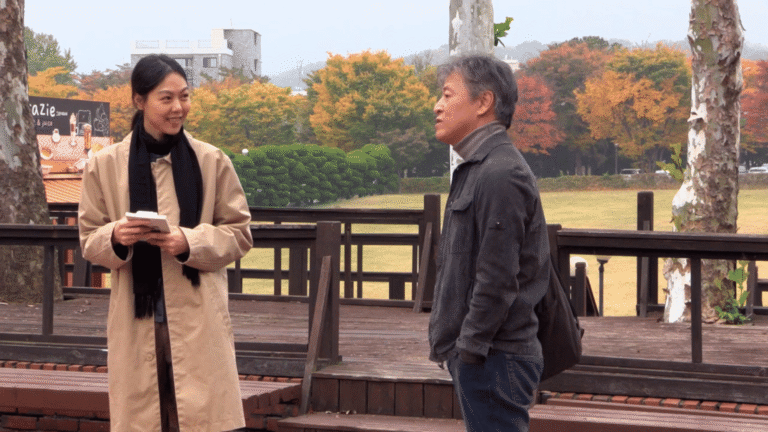
The beginning of Jimpa shows Hannah watching her teenage daughter Frances step into the Amsterdam home of their grandfather through a scene which Olivia Colman performs with absolute naturalness. The house displays itself as an impressive residential building. Handsomely decorated, someone might say. Full of art and memory and the accumulated wealth of a man who left his family to live more freely.
Hannah positions herself in the doorway while she performs her calculations. The end of his slavery period brought him no need to calculate money but it introduced new costs which America still handles today.
This is the question Sophie Hyde's film circles without ever quite landing on. Which is frustrating. And maybe also the point?
The story Jimpa needs to show how queer identity manifests between people of different ages while demonstrating the distance between previous freedom struggles and contemporary identity self-representations. The father in this story chose his personal desires but his daughter spent her entire life avoiding all choices. John Lithgow plays Jim, the titular grandfather, as a man of considerable charm and equally considerable selfishness. He departed Adelaide when Hannah reached the age of thirteen. Moved to Amsterdam. The activist lived his entire life among fellow activists and aging queens and survivors who had survived the plague which killed many from his age group. The movie shows that he has worked to achieve his happiness.
Earnings require a system which maintains financial records through a ledger that contains two separate sections.
The economic subtext here isn't subtle, actually, no, let me correct that. The issue lies in its unobtrusive nature which makes it difficult to detect. Hyde shows reluctance to question the comfortable life which protects Jim's selected family unit and the financial support that enables Frances to plan a European gap year despite her mother working on a movie about the same traumatic experience she would face during her gap year. The Amsterdam scenes reveal something unintentionally exposing about them through their café brunches and their relaxed bohemian atmosphere and their belief that personal growth needs financial resources. Frances wants to connect with a bigger queer community which she believes is an acceptable request. The film shows community through visual elements which seem to depict actual property values.
Colman is doing extraordinary work here. I'll say that plainly. Hannah reveals to the casting director that her life story will focus on love instead of conflict although she knows this statement is false. She created a persona which helps her stay away from the necessary confrontation about her father's leaving. The character of Colman displays emotional austerity which functions as his survival method to stay operational although it prevents him from being truthful.
Lithgow maintains his normal state of being. Charming when charm is required. The performance and writing style create a level effect which makes Jim defend himself in a debate instead of showing his human nature in that environment. The older gay men who survived multiple years of loss appear in his story as a fast-drawn background group that fails to create any meaningful impact.
And Frances?Aud Mason-Hyde delivers a vulnerable and uncompleted performance as the character in Sophie Hyde's film. The script fails to establish any purpose for these characters because it only uses them to represent their time period. The scene where Frances discovers Amsterdam's queer nightlife should be full of exploration but it presents like a classroom lecture.
The story takes a surprising turn in its last section which I will not reveal but it starts without warning and stays for an extended period. Kate Box enters the scene late as Hannah's sister who quickly displays what the ongoing conflict between them has been like since the beginning. The movie uses its entire supply of good feelings to show us emotions through montage and flashback sequences instead of allowing us to experience them naturally.
Still. There's something here which I continuously think about. The image of Hannah in that doorway. We do not know what genetic information we inherited from our ancestors who lived before our time. A house functions as an active building which also serves as evidence against someone who committed a crime.
I don't know if Jimpa is good, exactly. The idea has continued to occupy my mind even though I have not pursued it further.