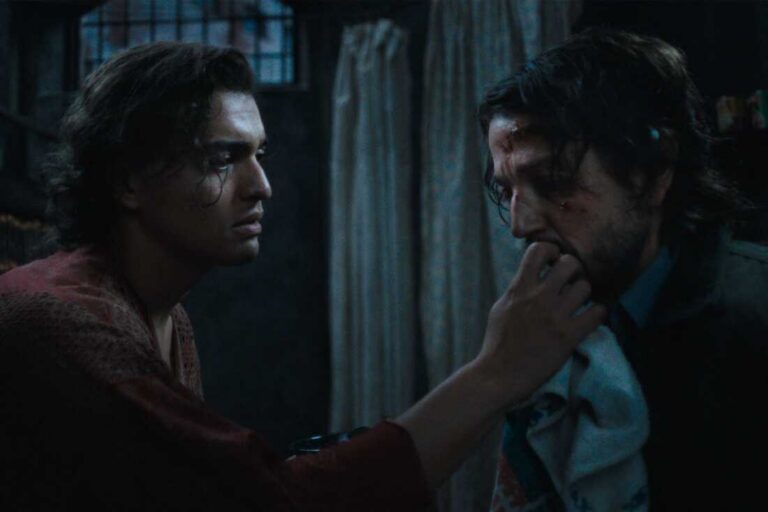
Ten million dollars. That's reportedly what Brady Corbet spent making The Brutalist, which sounds like a lot until you consider that the film spans thirty years, shoots in VistaVision, and features marble quarries in Italy. The person who did this calculation took great care to perform all the necessary calculations. The movie presents itself as a work about artistic expression and immigrant experiences during the American era yet it actually explores the price artists must pay for their creativity and who bears the expense of their work.
László Tóth moves to Pennsylvania while carrying a broken nose and his Bauhaus academic background. The character of Adrien Brody presents himself as a person who bends while observing everything because he spends his time recording financial records. His cousin Attila has already made his bargain with America, changed his name, invented fictional sons for the furniture business because customers trust a family operation. László performs an evaluation of the shop chairs which he presents with proper business etiquette yet he completely disapproves of them. Not beautiful.
The process of assimilation operates through economic systems which do not allow any space for beautiful elements.
A man spends three and a half hours working to create enduring structures in a nation which focuses on short-term deals. Harrison Lee Van Buren discovers László's talent through his inherited wealth which he uses to find new things in the same way wealthy people do. He commissions a community centre to honour his dead mother. The project will take years. The budget will shift. The power dynamic will not.
Corbet and co-writer Mona Fastvold understand something essential about patronage.
Van Buren doesn't just want a building. He wants to experience the joy of possessing the person who will create this design. The character shows László's tired coat through a natural conversation which needs no special effort to share but provides the most important information to the audience. Pearce delivers the information through a gentle method which provides defense to the audience.
The brutalist structures László creates, those concrete slabs and unforgiving angles, are meant to represent permanence. "The best way to describe a cube exists within the physical form of a cube according to his statement. His statement about the cube functions as a declaration but reveals his state of being drained. His desire for simplicity stems from the fact that his existence brings no simplicity to his life. The wheelchair-bound European-born Erzsébet shows her inner power to the world as she appears before Felicity Jones. His niece won't speak. László developed heroin addiction which he supported through his poverty and his feelings of social isolation because he stood out in a community that did not accept him.
The marble quarries remained in my thoughts from start to finish of the entire process. Corbet captures these buildings through his lens which transforms their white stone structures into new creations. The sound design gives you every crack and rumble. The building design reveals its authentic beauty while demonstrating that construction requires mining operations to obtain vital resources. Someone quarries the stone. Someone else determines what the outcome will be.
The film uses its long duration to create confusion between its actual emotional depth and its extended duration. The second part of the story presents new challenges which appear to stem from a different dramatic film. Van Buren's villainy calcifies into something almost cartoonish. A piano which drops to the floor produces the same effect as when someone finds crucial information just before time runs out.
The entire structure maintains its structure because of Brody. The character finds his best moments when he remains silent because Corbet provides him with numerous silent moments. The entire story emerges from this face which displays all its angular and shadowed features instead of needing any spoken words. The completed building appears to László in the 1980 epilogue without any need for spoken words. The building design expresses his personality through its design elements.
The entire VistaVision format achieves its worth because of Lol Crawley's outstanding work as a cinematographer. The Philadelphia jazz clubs operate in a humid climate.
The mansion of Van Buren creates a feeling of being trapped through its entire dark wooden structure which seems to carry heavy expectations. The shallow focus technique continues to separate László from other people in crowded spaces which serves its intended purpose.
The film ends with disco, of all things. The song "One for You, One for Me" by La Bionda accompanies the end credits as it seems to mock or express sadness about the way things have turned out. The title becomes more than ironic because it accurately describes the situation after watching the artist spend three and a half hours trying to protect himself from exploitation. One for the patron. One for the artist. The proportions vary.