A loan officer in Rebuilding shows Dusty why his burned-out land lacks enough value to support the paper used for his loan application. The soil fails to produce. The fire risk is too high. By every metric the institution uses to measure value, this place is nothing. The spreadsheet does not show the burial site of Dusty's parents because it seems to have no ability to display this information.
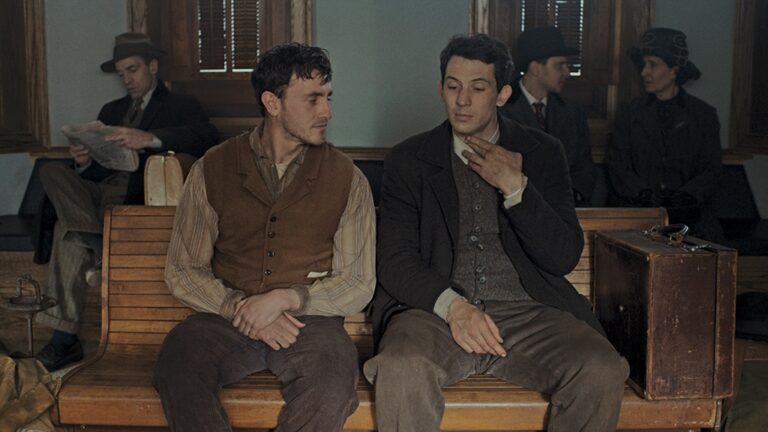
The second feature by Max Walker-Silverman reveals a fundamental truth which most disaster movies fail to depict because the actual disaster occurs when the building catches fire. The systems which should have helped your recovery process revealed their true nature by showing they operated for different types of people. Josh O'Connor delivers a haunting performance as Dusty who exists within the boundaries of his Colorado ranch property. The ranch loses its property to wildfire which forces him to move into a FEMA trailer camp where his tall body must fit into short-term housing that shows him his stay is only temporary. That he is provisional.
The movie shows which characters succeeded in taking breaks for relaxation but the other characters had to continue their work without any rest. Dusty can't. His body is always slightly too large for the spaces allotted to him, always adjusting.
The main strength of Walker-Silverman emerges through his refusal to create a simple redemption story where Dusty discovers daughterly love which fixes all his problems. Yes, Callie-Rose (Lily LaTorre, genuinely astonishing) draws him out. Yes, she decorates his trailer with glow-in-the-dark stars while he teaches her to saddle a horse. The small acts of kindness operate independently from solutions which work to solve the core issue of institutional abandonment. They're survival tactics. The trailer camp develops mutual aid systems which Kali Reis's character Mila organizes through cookouts while displaced people establish new family bonds through their shared living situation. Walker-Silverman documents the institutional breakdown through his unjudging lens which shows how people form new family bonds when institutions collapse.
Dusty delivers his words about lost items to the group during dinner but O'Connor expresses them through his character's deep inner reflection which spanned multiple months. The grammar of it is important. Not things he's forgotten. Things he'll never even know were gone.
The visual elements in the film also play an important role. Cinematographer Alfonso Herrera Salcedo shoots the Colorado landscape as simultaneously ruined and impossibly beautiful, purple and orange streaking across dusk skies while the characters eat together on folding chairs. There's no contradiction in this. The land shows its ash-covered terrain while revealing its stunning natural beauty. Dusty maintains his ability to perform small acts of kindness even though he has become broken. Walker-Silverman who spent her childhood in Telluride demonstrates deep understanding of these areas because she understands that destruction fails to diminish the love people have for their environment.
The movie shows resilience through its unflinching depiction which avoids any attempt to make it look beautiful. These people do not inspire me. They're just still here.
The film presents a few moments which approach an overly simplified resolution during its last section. The decision Dusty faces about staying in his present location or moving to Montana for work does not produce the same intense dramatic effect which Walker-Silverman seems to want because the film has already established its emotional foundation. We understand what truly matters. The team continues to wait for Dusty to arrive at our location.
O'Connor works on projects which operate without making any public declarations because he allows empty spaces to express what words cannot. The British actor who plays a Colorado cowboy should display his foreign origin through his performance. It isn't.
He found the precise body stance which showed how someone who based their identity on work and land ownership lost both of these things. He declares "That's not who I am" to show his refusal of highway work which reveals his true nature. He remains unaware about his identity because he lacks understanding of the circumstances which formed his personality.
The economic elements in this situation exist as plain text rather than hidden information. They're text. The bank refuses to provide funding because the property lacks ability to generate income. The FEMA trailers are falling apart. Dusty must abandon all aspects which bring purpose to his existence because they represent his only possible solution.
This is what happens when value is defined purely by extraction and yield, when a family burial plot registers as nothing on a balance sheet.
And yet. The glow-in-the-dark stars. The borrowed heirlooms. The grandmother kept his personal items because she loved him rather than following any rule.